Studio One 4 Impact
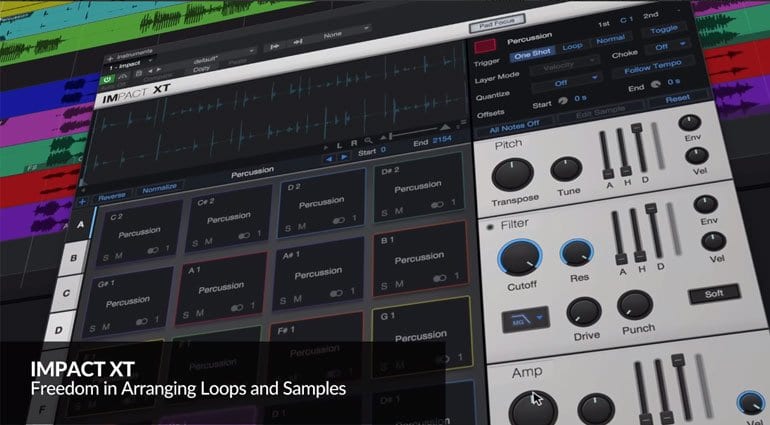
Screen 1: Impact XT has tremendous capability to build up large sound sets.
PreSonus Events One of these days, we’ll be in your town—and this calendar will tell you when, where, and what we’ll show you. Answers Ask and answer questions with PreSonus users just like you! Studio One 4: Work better, faster.
- Studio One Setup for Impact Controllers. Important: Make sure that you install the Studio One integration files for Impact after installing Studio One. If you accidentally ran our installer before installing Studio One, Studio One will not recognize your Impact series keyboard.
- May 28, 2018 In this tutorial we take a detailed look at all of the parameters included in the new Impact XT drum machine, included in the latest Studio One 4 release. Find me on the web: https://www.
New features in Studio One 4 make it even easier to add interest to sequenced patterns.
Studio One 4 is here, and there is plenty to explore. This month, I take a brief look at the fun to be had combining two new additions. Patterns is a step sequencer, more or less in the style of old hardware drum-machine sequencing, and Impact XT is an improved version of the existing Impact drum instrument. In this workshop we’ll only cover a narrow subset of what these features can do — for instance, I won’t even mention the melodic mode for patterns — but that should be enough to convey how far you can go with them.
Some audio examples making use of probability, as well as the other techniques described here, can be found by viewing the online version of this article.
Rhythmic Itches
I get bored of things that repeat in exactly the same way every time, so this column will look at how Patterns and Impact XT can create entire rhythmic worlds quickly and without too much effort. I’ll explain some of the techniques I use with these tools to go from a simple step sequence to a surging, changing world of rhythm.
First, load up on sounds. Impact XT has eight banks of 16 pads, each of which can stack up to four samples. This is a lot of sounds that can be stored and played, especially given that the samples don’t have to be only short drum sounds — they can be loops or long sounds. Load a kit you like, and then drag and drop sounds from the Finder or Windows Explorer onto pads in other banks to build a big, fat sound set. In Impact XT, to stack a sample onto a pad’s existing samples, you no longer Shift-drag the sample to the pad: instead, click the plus-sign button below the lower-left corner of the waveform display. You can still drop up to four samples onto a pad at once to stack them. (See Screen 1.) Once you’ve put the work into creating a kit, save it for posterity.
Second, create some Patterns. Studio One 4’s Patterns takes a basic grid approach to sequencing, but throws in some fun twists. The first is variations. As the name indicates, variations can be modified versions of an original sequence, but a variation also can be an entirely different pattern.
Insert a new pattern by locating to the track and time where you want it and pressing Shift+Ctrl+P. On the left of the familiar drum machine-style grid is a sample list; this might get a tad long if you load lots of samples, but it helpfully shows the sample names. Sequences currently can only be programmed by mouse-click or using step record, but hopefully, programming from a MIDI pad controller control will be added soon. Make a pattern you like, and you are at the starting line. Time to make some variations!
The buttons at the top of the list duplicate or add a new variation. I use them roughly equally. Duplicate a pattern and move some notes into an interesting new version of the sounds and rhythms in the original. Once you’ve created several variations, loop a single iteration of the pattern in the track, hit the space bar to play, and click different variations (in their left columns) to play them. Jam out.
Stepping Out
Variations don’t have to have the same number of steps as each other, or the original pattern. I kept things relatively simple in Screen 2, setting one variation to 12 steps, while all the rest had 16, but this was still sufficient to introduce a clear polyrhythm. Even with only variations double and half the original length, you can get some stuff happening.
Screen 2: The Pattern editor. The buttons immediately below the ‘Variations’ legend create new or duplicate variations.
Patterns can be inserted on any instrument track, and each copy of the pattern in a track can be set to play a different variation. You can stack patterns on a track and they will play merged, making it a snap to build polyrhythms or create transition overlaps. You could also use multiple tracks of variations playing separate instruments in the same Impact XT kit to gain closer control of the sounds and rhythms.
The default velocity value for inserted notes is of 60 percent, but it’s easy to alter this. Select a row (instrument) in the grid and click Velocity in the row of parameters below the grid. The bar display shows the velocity of each note in the selected line: drag the bars to edit them (Screen 3). Velocity editing can create nice phrasing and note-to-note sound differences, and can bring out a sub-rhythm, while lower-velocity notes can simultaneously suggest yet a third, ‘ghost’ rhythm.
Screen 3: Velocity editing in the pattern editor. Note how the last four notes use velocity to sculpt a quick little crescendo.
On many instruments, note velocity also produces tonal change, yielding greater diversity of sound. Impact XT’s velocity control of pitch can go to yet another level of phrasing. The ‘secret sauce’ is in tuning the velocity amount to cover the right pitch range. Applying positive velocity modulation may mean you need to move the tuning or transposition down if you want the sound centred around the original pitch, or, conversely, pitch it up for negative modulation values.

Screen 4: Small amounts of pitch and filter velocity modulation, but full-on level modulation for this sound. Note that even with positive modulation, the pitch is transposed up a little, not down. This sound will always play back at least a little higher than the original. The filter is a low-pass in this case, which gets just a touch of velocity mod.Finally, velocity can be put to use controlling filtering per pad for still more tonal alteration. The most obvious tactic — and still a great one — is applying velocity to the cutoff frequency of a low-pass filter, such that softer notes are darker and louder notes brighter. That emulates the sonics of many acoustic instruments and works effectively in most circumstances (see Screen 4).
But another filter mod technique I like is applying a band-pass filter with velocity control of the cutoff frequency. Impact XT offers two band-pass filter types (‘ladder’ and ‘state’) for pads. Choose a filter type and the intensity of the effect will be determined by the modulation amount and the filter resonance.
Infinite Probabilities
Variations and velocity are quite enough to make engaging step sequences, but my new hands-down favourite feature for creating variety in a pattern is the Probability parameter. Here’s a few tricks to getting the result you want from this powerful feature.
First, select a sound and choose the Probability parameter below the grid. A bar graph appears showing the probability that each sound will play on any given pass through the sequence. At the default 100 percent, a note sounds every time; at 50 percent, it will play only half the times through (Screen 5).
But how many times through are we talking about? A history looking only at four passes through the sequence gets pretty predictable once the first pass is done. If the history looks at the last 20 times through the sequence, it gets more complicated. A note set to 50 percent might sound six times in a row, followed by two silences, two more notes, eight silences.. nothing that feels close to ‘every other time’, but still, statistically, 50 percent.
Screen 5: This is a pretty dense pattern, so none of the note probabilities on this instrument are even set as high as 60 percent. The result will still be quite active, but will not feel cluttered.In practice, probabilities of perhaps 75 percent or more feel to me like the note plays every time, even though it is noticeable when it is absent. That feel of continuity makes high percentages good for bass drums or other time-keeping elements, which you want pretty steady, though with a little give and take here and there. At the other end of the spectrum, values below 10 percent are useful when triggering long samples or loops, to reduce the chances of multiple copies of the sample playing on top of each other. At percentages that low, you lose all sense of that note as part of a rhythm.
Ableton Live Suite v10.1.6 OverviewCreate bolder sounds with Live’s new devices. Stay in the flow with a multitude of workflow improvements. Do even more away from the computer with Push. It is full offline installer standalone setup of Ableton Live Suite v10.1.6 Crack mac for 32/64. Ableton max for live essentials free download full. SubmitAbleton Live Suite v10.1.6 Crack Free Download r2r Latest Version for Windows.
In between these extremes, I’ve been setting many notes between 15 and 30 percent, to keep down clutter in patterns with busy rhythms and lots of sounds, while for general instrument riffing, 35-65 percent retains the basic feel but sounds more like groove than repetition. As you raise a note’s probability, it tends to become fundamental to the rhythm.
Variety Show
The ’80s were tragically tainted by four-bar drum loops that repeated identically for minutes at a time. Studio One 4’s Patterns and Impact XT make that trap easy to avoid. With the ability to have a very large number of sounds on tap and a number of different tools for shaking up the sequence, entire pieces can be composed using just these tools. We will tackle more new Studio One 4 features, but this one can hold you for a while.
Audio Examples
Download 1.9 MB
An Impact kit entirely devoted to cymbals and cymbal effects: ride ping and bell, crashes, chokes, stick slides, rolls and so on. Most pads have more than one sample. To the processor, Impact does not have a heavy impact, so several instances, such as this cymbal kit, can easily be used in a song document.
Studio One’s Impact drum machine has hidden depths that are well worth exploring.
Impact is one of the virtual instruments that has been bundled in Studio One since its earliest days. It might look like a standard drum machine, but Impact has some cute tricks up its sleeve (drum machines have sleeves, right?), a number of which are not documented very well (or at all). This month, I’ll share some of them.
Get Padded Up
A drum machine is a sample player optimised for playing percussion sounds and making beats. PreSonus bundle quite a few kits with Impact, and more are available from third-party developers like MVP Loops and The Loop Loft, but making your own kits is as easy as dragging individual sounds from Studio One’s browser and dropping them on Impact pads.
Impact’s sample editing includes a zoomable waveform display, velocity switching, sample trimming, and auditioning of a sample by selecting it in the velocity range bar.A sample can be trimmed to remove silence at the beginning and/or end using the Offset Start and End settings below the waveform display. Getting these trims right often necessitates zooming in and out on the data, and Impact hides the tools for this in plain sight. A long and a short bar run immediately below the waveform display; the shorter bar on the right sets the size of a window on the data, while the longer bar on the left moves that window through the full length of the sample.
Each Impact pad can trigger up to four different samples, which opens many possibilities. The most common and obvious use for this is velocity switching. Perhaps you want samples of a snare drum being hit very quietly (pp), fairly quietly (p), kind of loud (f), and really loud (ff). Adding samples to a pad is as easy as holding down the Shift key while you drag and drop the sample onto the pad. Each sample is added to the high end of the velocity range, so plan how you want the samples laid out in the velocity range and drag them starting from the quietest sample and working up to the loudest. A sample can be removed by clicking it in the velocity bar and then clicking the ‘minus’ button to the right of the Prev button below the waveform.
Studio One 4 Review
By default, the full range of velocity values is evenly divided between the samples dropped on the pad. The range assigned to each pad is visible in the bar above the waveform display. Clicking in the velocity range bar plays the sample assigned to the range you click. However, equally sized velocity ranges for each sample are rarely desirable in practice, at least, when any amount of realism is the goal. Generally, it is better for relatively few hits to sound the very loudest and softest samples, while most hits trigger the middle samples. The best range sizes will vary depending on the sounds, controller, musical genre and your playing style. Thus, you will usually want to customise the velocity range assigned to each sample. This is easily done by dragging the range boundaries in the velocity range bar.
But there is more than one use for having multiple samples on a single pad, which brings us to another of Impact’s clever tricks. Click the Layer Mode field in the lower right corner of the Impact window and you will find that Velocity is but one of three ways Impact can use samples layered on a pad. Round Robin simply steps through the samples, sounding the next one in the list with each hit before cycling back to the first and so on. You are not required to have four samples on a pad, and I sometimes use only two in Round Robin, so that the pad alternates between them. For instance, I might load up a ride cymbal and a cymbal bell strike for playing an eighth-note ride part. Then I need only program my eighth notes to get a funky part with the cymbal bell on offbeats and a ride on the beat.
The other Layer Mode choice is Random, a mode in which, as you would expect, each strike causes one of the stacked samples to be chosen at random and played. This can be useful just to introduce variety different from that created using velocity sensitivity.
The Long View
Although Impact is intended for playing drum and percussion sounds, you can load any sample you want onto a pad. Loading longer samples makes Impact function as a triggered clip playback system. I haven’t had the patience to find out if there’s an upper limit on the length of the samples that can be loaded, but if you’re going down this road, there are a few things you should know about the block of controls in the lower right of the Impact window.
The key to using long samples in Impact is the Decay slider, which must be all the way up to play a very long sample.The Play Mode field has a drop-down menu with four choices. One Shot Poly plays the entire sample, with additional triggers starting additional copies playing; One Shot Mono plays the entire sample, with additional triggers cutting off and restarting playback. In Toggle mode, the first Note On message starts playback and the next stops it, while in Note On/Off mode, the Note On message starts playback and a Note Off message stops it. What all of these modes have in common is that they are supposed to allow playback of the entire sample — but the length of playback is actually determined by the AHD envelope controls in the amp section just above.
Given that, you might think that to play back a two-minute long sample you need only slide the Hold slider all the way up, where it displays an infinite hold time value. In fact, however, that only enables playback of about 10 seconds. Darn! Here’s the secret: slide the Decay slider all the way to the top. As I said, I can’t say just how long it will play, but the 20-minute sample I started in Toggle mode as I was writing this has been toodling along for well over 10 minutes so far.
Ableton Live 10 Suite 10.1.2 Mac OS Torrent Features Create and edit multitrack recordings in a straightforward linear view. Switch to this one-of-a-kind interface to improvise and experiment with countless sounds and loops. Oct 09, 2019 Ableton Live 10.1.2 Crack for Windows and Mac: it is a complete and famous digital audio studio with track sequence function to develop excellent soundtracks and stellar performances. The program offers many splendid tools for organizing, modifying, combining, editing, mixing and recording, as well as composing audio tracks. Ableton Live Suite 10.1.2 Download Ableton Live Suite 10.1.2 Create bolder sounds with Live’s new devices. Stay in the flow with a multitude of workflow improvements. Do even more. Oct 09, 2019 Ableton Live Suite 10.1.2 Crack + Serial Key Full Latest Ableton Live Suite 10.1.2 Crack is specially designed by keeping in mind the real essence of the music. Freely and independently start and stop any number of audio or MIDI loops in real-time, all without interrupting your creative flow. Ableton live 10.1.2 crack mac.
Change It Up
Impact does not have all of the processing resources of Studio One’s Presence virtual instrument, let alone the editing and processing of a full-featured sampler like MOTU MachFive 3 or Native Instruments’ Kontakt. But it does have a few nice sample-shaping features. One such is the multimode filter on every pad, offering three different variations each of low-pass, high-pass and band-pass responses.
The filter for each pad can be selected from a list of nine different filter types.I like the sound of these filters on drum samples, and combined with the hard-wired envelope and velocity modulations, they can produce some great sounds. For one project, I dragged a left/right pair of snare samples onto two pads, applied a band-pass filter with cutoff modulation to the left-hand stroke sample only, and panned them slightly left/right, just outside of the centre: a great sound, quickly arrived at. The high-pass filter, likewise, can produce great variations on a sample. Creating variation with filters is very useful when you have only a single sample of a sound.
The Stretch Factor field in the bottom right corner of Impact is another fun resource. It is actually a playback rate control, a speed multiplier. You can set this parameter within a range from 10 (plays 10 times normal speed) down to 0.1 (10 times slower than normal speed). Try applying a setting of three or four to a cymbal sample for a complex and interesting sound. Interestingly, Stretch Factor appears to be the only parameter besides sample start and end that can be set on a per-sample basis, rather than on a per-pad basis.
Impact demands surprisingly little processor power, which opens the door to using multiple instances. One instance might be dedicated to snare drum: left and right hand strokes, rim shot, side-stick, brushes, rolls… the works. A second instance might be for cymbals. You probably won’t need a dedicated instance for kick drums, but, hey, I once saw the great Billy Cobham playing with 10 kick drums.
Studio One 4 Impact Mpc Skin
People often make beats by adding parts while a sequence loops. The Track / Transform / Transform to Audio Track command lets you capture what you have recorded this way. I sometimes do that to get an audio rough I can play with. When you are ready to perform the final mix, choose the Event / Explode Pitches to Tracks command for easy processing and mixing of each element separately. Doing so also makes it easy to archive parts by transforming each track to audio when the project is done.