How To Get More Drum Kits On Garageband Mac
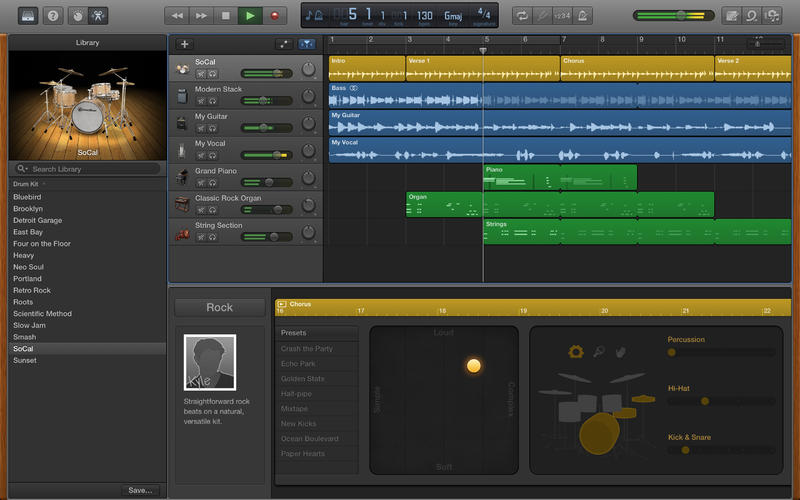
Click on the Apple Loops button on the far right of the control bar (the middle button in that group) to expose the Loops pane. In the Search field type in rock and press Return. Now click the Bass button at the top of the Loops pane. Locate the Picked Rock Bass 01 entry and click on it. I like nearly all of Apple’s $99 Jam Pack add-on sound libraries for GarageBand (Voices doesn’t do a lot for me), but I also like free. And when I think free and GarageBand I think SoundFonts. Click the button that corresponds to the instrument you’re using. Click the Kits button in the Loop Browser, and a list of different beats appears in the pane at the bottom of the Loop Browser window. Click one of the loops with a green musical-note icon. Aug 22, 2019 If you use GarageBand on your iPhone or iPad, you can browse through and download Apple Loops there just as easily. Pop open GarageBand and create a new song or open an existing one. Then, do the following to get your loops. 1) Tap the Loop Browser button on the top right. GarageBand lets you play virtual drums manually. On macOS, select a drum kit and use musical typing or a connected USB piano keyboard to trigger sounds. On iOS, create a Drum track using the Acoustic Drums option. On iOS, the drums are velocity sensitive, and acoustic kits offer different sounds depending on where the drum is struck. Did some more research on drummer and it turns out that in the new logic drummer you can choose to select the producer kit version of the kit and that opens up all of the drums on to separate tracks so that you can eq them. A feature I assume they took off of the garageband version. Maestro Breen returns with another Mac 101 lesson. Get your groove on with GarageBand loops. Let’s also make the bass drum a little more pronounced by adjusting the Kick knob so that it.
To get started using Beat Sequencer, either create a new song or open an existing one. If you've created a new song, the Sound browser opens automatically. If you want to add Beat Sequencer to an existing song, tap to open the Sound browser.
In the sound browser, swipe until you see Drums, then tap Beat Sequencer.
Quickly add a beat to your song
In Beat Sequencer, tap , then choose the pre-designed pattern that best describes the style you want. The pattern plays back at the tempo you’ve set for your song, and loops depending on the length of the pattern. Each pre-designed pattern has unique settings, including the pattern length, which you can change.
It also includes Ableton Link so you can collaborate with other musicians on the same project from multiple devices. Live’s studio effects – Compressor, Gate and EQ Eight are adapted with new displays, improved controls and improved sound.AUDIO TO MIDITransform your favorite drum break with the drums-to-midi feature, and use it with your own sounds. Ableton live 10 download for pc cost 2017. For that reason, this digital audio workstation earns best pick for Live Performance.GLUE COMPRESSOR AND EQ EIGHTAbleton Live Suite’s new Glue Compressor (made in collaboration with Cytomic) is based on a classic bus compressor from the 80s, both for its great sound and for its easy handling.
To stop and start to the pattern, tap . If you want to add the pattern to your song, record the pattern.
You can change the pattern by turning steps on or off. Each row corresponds to an individual instrument in the drum kit, which is shown along the left of the grid. To turn off a step in the pattern, tap a lit step in the grid. To turn a step on, tap an unlit step.
You can also change the sounds in the pattern. To change the entire kit, tap button at the bottom of the screen that shows the currently selected kit (such as Trap Door or Hacienda). In the Drums window, select the style of sounds from the left column and the individual kit from the right column. To download additional sounds, tap 'Get more drum kits,' then select the sounds you’re interested in from the Sound Library. When you’ve found the kit you want, tap Done.
Build your own beat
If you want to build your own beat from scratch, tap the , then choose New Pattern. Tap Step/On Off to add and remove steps. You can add and remove steps while Beat Sequencer is playing back or idle.
After you’ve added steps, you can edit each individual step:
- To change the volume of a step, tap Velocity. Slide your finger down on the step to decrease the volume, and slide up to increase the volume.
- To slice an individual step into multiple steps, tap Note Repeat. Slide your finger upwards to increase the number of slices, and down to decrease the number of slices.
- To add human-like variation to a step, tap Chance. Then, slide your finger down to increase the variation of the step.
If you want to edit an entire row’s settings, tap an instrument along the left side of the grid.
- To change an individual kit piece, tap Kit Piece in the Row Settings window, then tap the piece you want assigned to that row. That row now plays back the newly assigned kit piece.
- To change the length of each step in the row, tap Step Length, then select a length.
- To change the direction Beat Sequencer plays back that instrument in the pattern, tap Playback Mode, then choose an option.
When you've created your beat, you can save it as a pattern. Tap , then tap Save. Enter a name for the pattern, then tap Done. You can recall that pattern and add it to different songs.
When you're ready to add the pattern to a song, record the pattern.
Record the pattern
To record the pattern to your song, tap in the control bar. Beat Sequencer starts automatically. The pattern plays back in a loop until you stop recording. When you’re finished recording the pattern, tap Tracks view button to view the recorded track. Tap in the control bar to hear the pattern in the context of your other tracks.
After you’ve recorded the pattern, you can edit and adjust the track as you would any other instrument track.
View and Change Pattern Settings
Beat Sequencer uses steps to determine the length of a particular pattern. If your song is in 4/4 time, you can set the pattern length between 16 and 64 steps. If your song’s in 3/4 or 6/8 time, you can set the pattern length between 12 and 48 steps. You can also manually change the loop length of each individual kit piece by tapping the Loop Start/End button, then dragging the handle each row.
To view information and change settings for the current pattern, tap.
- Set length of pattern (16, 32, 48 or 64 steps in 4/4 time, and 12, 24, and 48 steps in 3/4 and 6/8 time)
- Set the step length (1/8, 1/8t, 1/16, 1/6t, 1/32)
- Set the Playback Mode (Forward, Reverse, Ping Pong, Random)
- Set the amount of swing in the pattern
- Reset the pattern. If you started with a blank pattern, tapping Reset clears the grid.
Using your MacBook, you can add loops to an empty track in GarageBand to build your song. You do that by listening to loops and making selections from the Loop Browser — Apple provides you with thousands of loops to choose from, along with more you can buy — and photos from your Media Browser. Click the Loop Browser button (which bears the loop symbol) to display your collection.
Look for the right loop
The track in this running example uses a Rock drum kit, but you haven’t added a loop yet. Follow these steps to search through your loop library for just the right rhythm:
Click the button that corresponds to the instrument you’re using.
Click the Kits button in the Loop Browser, and a list of different beats appears in the pane at the bottom of the Loop Browser window.
Click one of the loops with a green musical-note icon.
Go ahead; this is where things get fun! GarageBand begins playing the loop nonstop, allowing you to get a feel for how that particular loop sounds.
When you use only software instruments in a track, choose only software instrument loops, which are identified by a green musical-note icon.
Click another entry in the list, and the application switches immediately to that loop.
Now you’re beginning to understand why GarageBand is so cool for both musicians and the note-impaired. It’s like having your own band, with members who never get tired and who play whatever you want while you’re composing. (Mozart would’ve loved this.)
If you want to search for a particular instrument, click the Search box and type the text you want to match. GarageBand returns the search results in the list.
Scroll down the list and continue to sample the different loops until you find one that fits like a glove.
For this reporter, it’s Southern Rock Drums 01.
Drag the entry to your Rock Kit track and drop it at the very beginning of the timeline (as indicated by the playhead).
If you want that same beat throughout the song, you don’t need to add any more loops to that track. However, if you want the drum’s beat to change later in the song, you would add a second loop after the first one in the same track. For now, leave this track as is.
Whoops! Did you do something that you regret? Don’t forget that you can undo most actions in GarageBand by pressing the old standby — cmd+Z — immediately afterward.
When you compose, you can add tracks for each instrument that you want in your song:
Each track can have more than one loop.
Loops don’t have to start at the beginning; you can drop a loop anywhere in the timeline.
How To Get More Drum Kits On Garageband Mac Free
You put loops on separate tracks so that they can play simultaneously on different instruments. If all your loops in a song are added on the same track, you hear only one loop at any one time, and all the loops use the same software instrument.
Trap Drum Kits
By creating multiple tracks, you give yourself the elbowroom to bring in the entire band at the same time. It’s über-convenient to compose your song when you can see each instrument’s loops and where they fall in the song.
Drum Kits Download
Click the Reset button in the Loop Browser to choose another instrument or genre category.