How To Change Tempo In Garageband Ipad
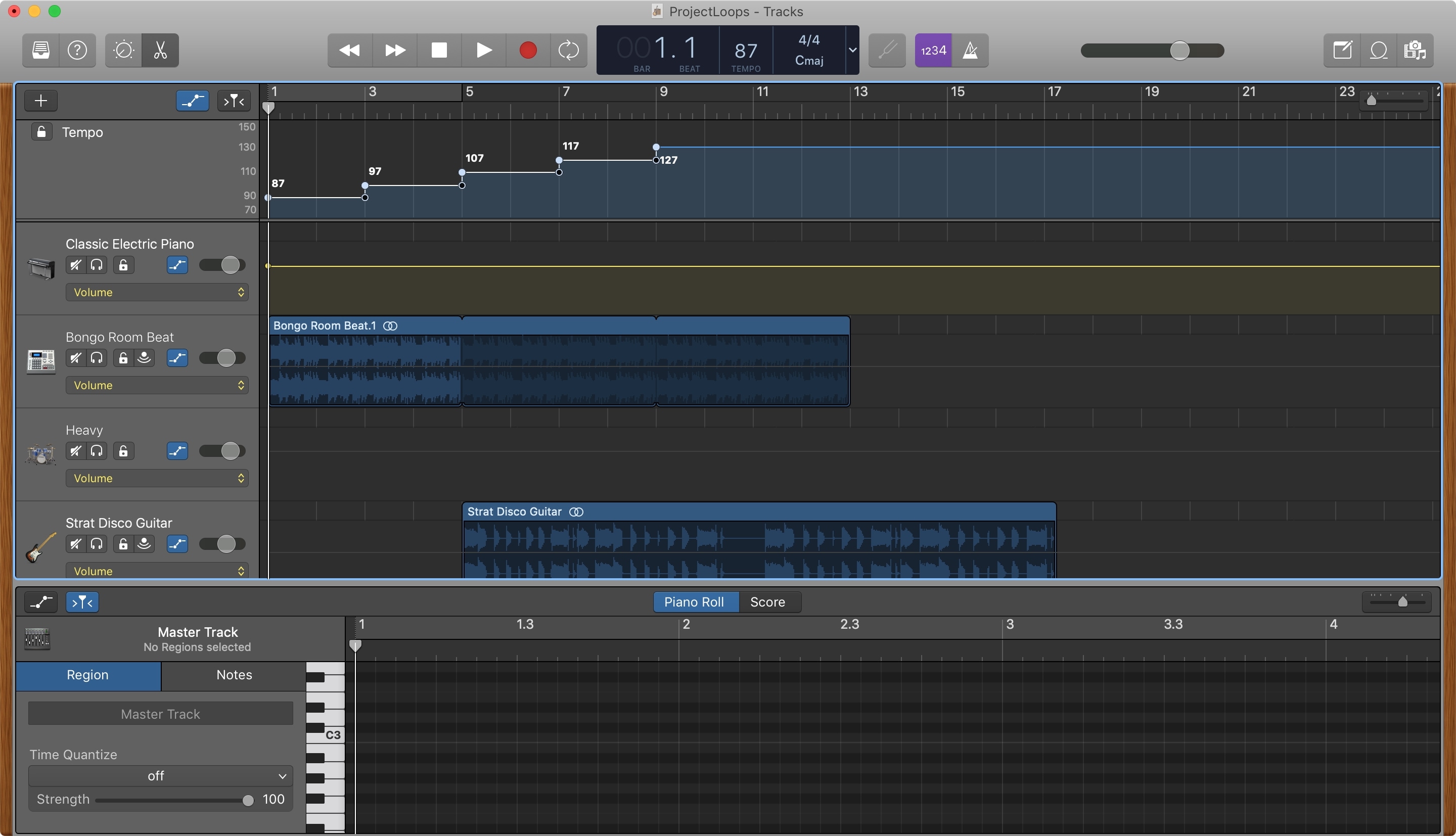
- Aug 28, 2017 In GarageBand you can change the tempo for all tracks at once, but not for an individual track alone. You change the tempo for selected measures using the Tempo Track, or change the overall tempo for the project. Recorded audio you recorded into GarageBand will adapt to the changed tempo. But not audio files.
- Apr 21, 2012 Apple WatchSpeciality level out of ten: 10. In response to ridergroov. Show the Master Track (main menu - Track - Show Master Track) and use the automation curve (master tempo) of the master track to adjust the tempo of the different parts of your song.
- Apr 14, 2016 This video explains how you can use an app called Anytune to change the tempo of music such as a playalong backing MP3 using your iPad or iPhone. It also explains how to download and store music.
GarageBand User Guide for iPad
Sep 16, 2019 How to change the tempo in GarageBand on Mac and iOS Change the song tempo in GarageBand on Mac. Adjust the Tempo Track on Mac. If you want the tempo to change throughout your song. Change the song tempo in GarageBand on iPhone and iPad. Wrapping it up. Setting the tempo for your song in.
Every GarageBand song has settings for the metronome and count-in, as well as the song tempo (speed), key, and time signature, which you can change at any time. You can also add an automatic fade-out.
Open the song settings
Change the metronome settings
GarageBand has a metronome to help you play and record in time. The metronome includes a count-in that plays before recording starts, to help you get ready. When the visual count-in is turned on, the metronome displays the beat of the count-in. In the song settings, you can turn the count-in on or off, and change the sound of the metronome.
Open the song settings, then tap Metronome and Count-in.
To turn the count-in on or off, tap the Count In switch. When the count-in is on, you can turn the visual count-in on or off by tapping the Visual Count-in switch.
To change the sound for the metronome, choose a new metronome sound from the list.
To change the volume of the metronome, drag the Metronome Level slider left or right.
Change the tempo of a song
Each song has a tempo (speed) that lasts for the entire song. You can change the tempo when either a Touch Instrument or Tracks view is open.
Open the song settings, then tap Tempo to show the tempo controls.
Do one of the following:
Set the tempo: Tap the tempo bar repeatedly.
Change the tempo incrementally: Tap the up or down arrow next to the tempo number. You can swipe vertically to change it in larger steps.
When you change the tempo of a song, recordings from Touch Instruments (except the Audio Recorder and Amp) change to match the new tempo. Apple Loops also change to match the new tempo.

Change the key of a song
Each song has a key that lasts for the entire song. You can change the key in any Touch Instrument or in Tracks view.
Open the song settings, tap Key, then tap a new key. You can also select a different scale (major or minor).
When you change the key of a song, recordings from Touch Instruments (except the Audio Recorder and Amp) change to match the new key. Apple Loops also change to match the new key.
Turn off Follow Song Key for recordings and loops
By default, when you change the key of a song, the recordings and loops in the song change to match the new key (except Audio Recorder and Amp recordings). You can turn off this setting if you want to try out different keys without changing the recordings and loops in the song.
Open the song settings, then turn Follow Song Key off.
Tap Follow Song Key again to turn it on.
Change the time signature of a song
Each song has a time signature that lasts for the entire song. You can change the time signature in any Touch Instrument or in Tracks view.
Open the song settings, tap Time Signature, then tap a new time signature.
When you change the time signature of a song, existing recordings and loops in the song do not change.
Add a fade-out
You can add an automatic fade-out to the end of a song. When you turn on Fade Out, the last ten seconds of the song fade to silence. If you extend the last section by adding or moving regions, the fade-out adjusts to the new end of the song. You hear the fade-out when you play or share the song, but not while recording.
Open the song settings.
Turn Fade Out on.
Tap Fade Out again to turn off the automatic fade-out.
Use 24-bit audio
When 24-bit audio is turned on, GarageBand records, mixes, and exports audio in 24-bit resolution. 24-bit audio uses more storage space, but provides higher resolution for audio editing.
Open the song settings, then tap Advanced.
Collision:Physical modeling synthesizer. Ableton live driver mac. Wavetable:Double oscillator and remap module way. Tension:A string physical model synthesizer. Analog:Motion analog synthesizer. Drum machines:A package of an emulator for traditional drum machines.
Turn 24-bit Audio Resolution on.
Send tempo information to music apps and MIDI devices
You can use MIDI clock to sync other music apps or MIDI devices to the tempo used in GarageBand when playing or recording.
Open the song settings, then tap Advanced.
Turn Send MIDI Clock on.
When you use Live Loops, MIDI clock is only sent when recording or playing back a Live Loops performance.
To get started using Beat Sequencer, either create a new song or open an existing one. If you've created a new song, the Sound browser opens automatically. If you want to add Beat Sequencer to an existing song, tap to open the Sound browser.
In the sound browser, swipe until you see Drums, then tap Beat Sequencer.
Quickly add a beat to your song
In Beat Sequencer, tap , then choose the pre-designed pattern that best describes the style you want. The pattern plays back at the tempo you’ve set for your song, and loops depending on the length of the pattern. Each pre-designed pattern has unique settings, including the pattern length, which you can change.
To stop and start to the pattern, tap . If you want to add the pattern to your song, record the pattern.
You can change the pattern by turning steps on or off. Each row corresponds to an individual instrument in the drum kit, which is shown along the left of the grid. To turn off a step in the pattern, tap a lit step in the grid. To turn a step on, tap an unlit step.
You can also change the sounds in the pattern. To change the entire kit, tap button at the bottom of the screen that shows the currently selected kit (such as Trap Door or Hacienda). In the Drums window, select the style of sounds from the left column and the individual kit from the right column. To download additional sounds, tap 'Get more drum kits,' then select the sounds you’re interested in from the Sound Library. When you’ve found the kit you want, tap Done.
Build your own beat
If you want to build your own beat from scratch, tap the , then choose New Pattern. Tap Step/On Off to add and remove steps. You can add and remove steps while Beat Sequencer is playing back or idle.
After you’ve added steps, you can edit each individual step:
- To change the volume of a step, tap Velocity. Slide your finger down on the step to decrease the volume, and slide up to increase the volume.
- To slice an individual step into multiple steps, tap Note Repeat. Slide your finger upwards to increase the number of slices, and down to decrease the number of slices.
- To add human-like variation to a step, tap Chance. Then, slide your finger down to increase the variation of the step.
If you want to edit an entire row’s settings, tap an instrument along the left side of the grid.
- To change an individual kit piece, tap Kit Piece in the Row Settings window, then tap the piece you want assigned to that row. That row now plays back the newly assigned kit piece.
- To change the length of each step in the row, tap Step Length, then select a length.
- To change the direction Beat Sequencer plays back that instrument in the pattern, tap Playback Mode, then choose an option.
When you've created your beat, you can save it as a pattern. Tap , then tap Save. Enter a name for the pattern, then tap Done. You can recall that pattern and add it to different songs.
When you're ready to add the pattern to a song, record the pattern.
Record the pattern
To record the pattern to your song, tap in the control bar. Beat Sequencer starts automatically. The pattern plays back in a loop until you stop recording. When you’re finished recording the pattern, tap Tracks view button to view the recorded track. Tap in the control bar to hear the pattern in the context of your other tracks.
After you’ve recorded the pattern, you can edit and adjust the track as you would any other instrument track.
How To Use Garageband Ipad
View and Change Pattern Settings
Beat Sequencer uses steps to determine the length of a particular pattern. If your song is in 4/4 time, you can set the pattern length between 16 and 64 steps. If your song’s in 3/4 or 6/8 time, you can set the pattern length between 12 and 48 steps. You can also manually change the loop length of each individual kit piece by tapping the Loop Start/End button, then dragging the handle each row.
To view information and change settings for the current pattern, tap.
Garageband Change Playback Speed
- Set length of pattern (16, 32, 48 or 64 steps in 4/4 time, and 12, 24, and 48 steps in 3/4 and 6/8 time)
- Set the step length (1/8, 1/8t, 1/16, 1/6t, 1/32)
- Set the Playback Mode (Forward, Reverse, Ping Pong, Random)
- Set the amount of swing in the pattern
- Reset the pattern. If you started with a blank pattern, tapping Reset clears the grid.